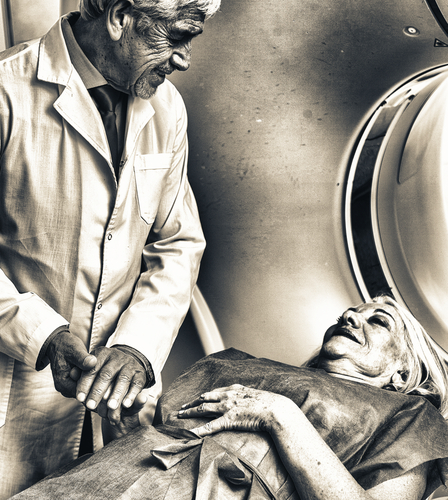
Pastoral Thanatology Program Article on Spirituality and Death

Death is not the end to spiritual people.  Death is a continuation.  Many view death as primarily an end point and something to be avoided at all costs, but death is as part of life as birth and plays a pivotal role in our development.

Spirituality is key in death.  Many may view life in a more materialistic way, but even so, spirituality without a higher end can be beneficial to the dying.  Spirituality and a commitment to something higher or bigger than themselves.  The traditional ideal of spirituality sees this in regards to religion, faith and a God, while others may see it as a way of life, or giving to the greater cause of humanity.  Spirituality allows one to approach death with more dignity and understanding.

Spirituality is key in embracing death and understanding the nature of its role in life. Please also review AIHCP’s Pastoral Thanatology Certification


In David Kessler’s book, “The Needs of the Dying”. he addresses five important stages and elements of spirituality. In some cases, death or the news of death bring about this stages and to them the benefits of death open one’s soul.  Spirituality is for the mind and soul, not the body itself.  Death can bring about a healing of the soul for the future existence.

Kessler points out that the first step is expression.  Expression is needed in regards to one’s physical ailment.  One needs to let the anger or grief out.  Many are angry at God for suffering and misfortune or why they have a particular disease.  It is important to express the feelings of death to be able to face them and understand them.  No particular feeling is wrong or right but are catalysts to understanding.

Following expression is a spirituality of responsibility.  One begins to take account of one’s life and begin to understand that not everything in life was everyone else’s fault.  Taking responsibility allows one to humble oneself and identify issues of life that were once so black and white and maybe see that the issues and common factors were oneself.  It can present an important spiritual transformation that without death could never occur.

Naturally following responsibility stems forgiveness.  One does not wish to die bitter and angry but instead looks to forgive. Death can bring broken and shattered families together in forgiveness.  One is able to set everything straight and see things far more clearly than before.  Petty arguments and proud stances become trivial when one is about to lose his or her life.

Acceptance of the death is also an important step in dying.  One may not desire to die but it is important to accept death when no other route is left.  One needs to learn from oncoming death what life truly is.  This is only possible when one faces death and accepts it as part of his or her continuing journey.

Spirituality in death helps one accept responsibility of life, forgive, accept and be thankful for life.

In this, spiritually, one should find some sort of gratitude.  Life is not defined by what was accomplished or how long one lived, but a life is defined by birth and death.  No life is incomplete.  Each life has a certain amount of time.  Gratitude for life and what has been given is key in spirituality when dying.  It cherishes what has been given instead of lamenting what was taken.

Spirituality is important in dying.  It helps one to understand the comprehensive nature of death.  Death is no longer an end point but part of a process and something that is as important to life as birth itself.  If  you would like to learn more about Pastoral Thanatology and the science of dying, then please review AIHCP’s Pastoral Thanatology Program and see if it matches your academic and professional goals.


 

Pet Loss Grief Counseling Program Article on Pets as Family

Pets are family to many people.  To some, they are the only family.  They are blessings and companions from God.  The innocence and unconditional love of a dog, cat or horse, or even smaller mammal is unargued.  While pets with more intelligence are able to express love more, individuals still form bonds with even animals with less intelligence.  This does not lessen the blow when an animal we love dies.  It is not something to be downgrade or be embarrassed about but a bond that should be acknowledged and respected in grief.

Losing a pet is like losing family for many. Please also review AIHCP’s Pet Loss Grief Counseling Program and see if it meets your academic and professional goals


The article, “Kevin McClintock: ‘We mourn our pets like a part of our family'” Looks at the value of pets in one’s life.  He states,

“Of course, when we lose a beloved pet, our thoughts often turn to the afterlife — at least mine do. I wonder where they’re at and what they do up there in the mists, waiting for their “humans” to come up there to be with them forever. ”

To read the entire article, please click here

Pets are family to many and individuals grieving the loss of family deserve respect in their grief.  Please also review AIHCP’s Pet Loss Grief Counseling Program and see if it meets your academic and professional goals.

Anger Management Consulting Article on Anger Styles

Anger can come in many forms.  Sometimes it is justified.  Other times is not.  Sometimes it is handled in a healthy fashion, while other times it is handled very poorly.  It can be passive or aggressive.  It is important to understand what type of ways you express anger towards others and work on healthier ways to express it.

How do you express your anger? Is it healthy or not? Please also review AIHCP’s Anger Management Consulting Program


The article, “There Are 5 Common Anger Styles. Which One Is Yours?” by Dara Katz reviews the five types of anger styles and what is the best style to express anger.  She states,

“So, understanding the way we typically act on anger helps us get to the crux of why our antennas are pointed up in the first place. And while a person can experience any numbers anger styles, here are the most five common ones, including how to spot them and what to do to make your communication effective and healthy.”

To read the entire article, please click here

Please also review AIHCP’s Anger Management Consulting Program.  The program is online and independent study and open to qualified professionals.  Qualified professionals can earn a four year certification by completing the program’s core courses in Anger Management


ADHD Consulting Certification Article on the Many Faces of ADHD

There are many symptoms and faces of ADHD.  Some individuals may day dream, while others may be energized.  Some may sit still and not pay attention, while others may run around and have endless energy.  Ultimately, ADHD is still the same problem and it is important for families to know what type of ADHD manifestation exists within their home.

Different children manifest different traits of ADHD. Please also review AIHCP’s ADHD Consulting Certification program


The article, “What Does ADHD Look Like? In My Family, It Depends on Who You Ask.” by Tracey Galgoci looks at the different manifestations of ADHD.  She states,

“No two people face the exact same challenges. There are common threads that may weave through each individual’s symptoms, but the presentation is as unique as each personality. Understanding this truth is key to bringing patience and empathy to our relationships and helping our loved ones with ADHD thrive. I am reminded of this truth every day by the three amazingly unique humans in my home, each one with their own set of ADHD challenges.”

To read the entire article, please click here

Please also review AIHCP’s ADHD Consulting Certification and see if it meets your academic and professional goals


Legal Nurse Consulting Training Article on Malpractice and Telehealth

With the emergence of new technologies such as telehealth, many great new advantages come, but also chances for medical malpractice.  It is important for primary healthcare givers to understand the advantages and disadvantages of telehealth and what can go wrong and how to protect oneself.

Please also review AIHCP’s Legal Nurse Consulting Program and see if it meets your academic and professional goals


The article, “6 things to know about telehealth medical malpractice concerns” by Jackie Drees looks at the some of the issues and problems that can arise from telehealth and what can possibly lead to malpractice.  She states,

“Telehealth adoption has accelerated during the COVID-19 pandemic, signaling the need for providers to examine their malpractice risks associated with virtual care. In a Sept. 29 op-ed for Bloomberg Law, Lindsay Lowe, a public health and healthcare law attorney at Wolfe Pincavage law firm in Miami, outlined potential medical malpractice concerns providers should be aware of when delivering telehealth services.”

With online breaches, poor connection, miscommunication or lack of proper observation due to technical limitations, it is important to work with clients and let them understand the potential issues with telehealth despite the advantages.  To read the entire article, please click here

Please also review AIHCP’s Legal Nurse Consulting Program and see if it meets your academic and professional goals


Pastoral Thanatology Certification Article on Pain Management

Pain is a natural nerve reaction telling the body that there is damage to tissue.  It is an essential warning device.  It sometimes hastens death and lets the person know the body no longer is viable and sometimes in death it can be absent.  Unfortunately, individuals cannot decide if pain will be present in their final days or not but every person has a right to die with as little pain as possible.  Physicians and family need to ensure their loved one’s receive the necessary pain management.

Pain management is important element of pastoral care. The right to die without pain is something all individuals deserve.


Pain management should be simple but it is not always simple.   Many individuals see pain differently.  Pain for the most part is dependent upon the individual.  This is why it is so crucial to express for the terminally ill or dying to express their levels of pain.  Doctors may prescribe pain medication levels for an average curve and supply too little for someone who may have a lower tolerance for pain.  It is important for individuals to let doctors know their pain level.  They need to express the type of pain, the level of it, the place of it, and its duration.

Some may seek to hide their pain, fearing if they accept certain medications, they are hastening death, but the reality is pain management is not about giving up, but instead, living in comfort with what days remain.  It is crucial and a right of every patient to be pain free or at least as pain free as possible.  Families who see their loved ones suffer, need to be the voice of those to weak to express their pain and ensure the proper medications and pain relievers are supplied.

Many doctors may fear the issue of addiction with greater pain relievers, but the fear of addiction is mute once a person has reached the threshold of death.  Death is coming and addiction of certain medications is not an issue nor ever should be.  Addiction can become a topic for discussion for pain management of the living, but never should be an issue for the dying.  Comfort and pain relief is the most important concern after someone has reached a certain point.

It is the duty of pastoral care givers and healthcare providers to provide the best comfort to the dying.  Physically, pain relief is one of the most important elements of pastoral care.  It is important to reduce or remove pain as much as possible for the dying so they may experience a death of peace and dignity when possible.

Please also review AIHCP’s Pastoral Thanatology Certification Program and see if it meets your academic and professional goals and needs.


If you would like to learn more about our Pastoral Thanatology Certification or would like to become certified in this field of care of the dying, then please review AIHCP’s program and see if it matches your academic and professional goals.  The program is for healthcare professionals and those involved in ministry and focuses on preparing individuals with the training and knowledge needed to help the dying and their families deal with end of life issues.  The program is online and independent study and leads to a four year certification.


Grief Counseling Training Program Article on Corporate Bereavement Policies

Grief does not consider careers or work schedules.  It comes regardless of project deadlines or important meetings.  Individuals who depend on their job need time to not only mourn the loss of their loved one but they also need to know their employer is there for them, supplying not only job security during tragedy but also emotional understanding and support.

Employees experiencing loss need support and security from their employer. Please also review AIHCP’s Grief Counseling Training Program


The article, “It’s Time to Rethink Corporate Bereavement Policies” by Mita Mallick looks closer at corporate policies for bereavement.  She states,

“While many organizations are rushing to rethink parental leave policies, wellness benefits, and extending our world of remote working past this pandemic, bereavement policies probably haven’t been at the top of many lists. Maybe this is because many of us are uncomfortable embracing death, grief, and loss in the workplace.  But this is the right time to consider bereavement leave. How can organizations better help grieving employees? ”

To read the entire article, please click here

Bereavement over the lost of a loved one is a difficult time and it is important that employers and corporations make that time easier. Please also review AIHCP’s Grief Counseling Training Program and see if it meets your needs and goals.


Stress Management Consulting Program Article on Stress and Proper Breathing

When stress strikes, we respond with fight or flight mentalities.  We hence physically emit certain physical characteristics with the emotion associated with it.  If one can breathe properly, they can reduce stress.  They correlate the breathing patterns associated with less stressful emotions.  This in turn can fool the mind into a more relaxed state.

How we breathe and refocus during stress plays a large role in how our body responds to stress. Please also review our Stress Management Consulting Program


The article,  “Research: Why Breathing Is So Effective at Reducing Stress” by Emma Seppälä , Christina Bradley  and Michael R. Goldstein look at how studies show that better breathing can help reduce stress.  They state,

“Research shows that different emotions are associated with different forms of breathing, and so changing how we breathe can change how we feel. For example, when you feel joy, your breathing will be regular, deep and slow. If you feel anxious or angry, your breathing will be irregular, short, fast, and shallow. When you follow breathing patterns associated with different emotions, you’ll actually begin to feel those corresponding emotions.”

To read the entire article, please click here

Please also review AIHCP’s Stress Management Consulting Program to learn more about how one can reduce stress and utilize breathing as an effective strategy in reducing stress.

Grief Counseling Training Program Article on Depression and Fatigue

Many individuals experience fatigue and tiredness.  It is not necessarily a sign for alarm, but in some cases,  chronic fatigue can point to a deeper issue.  Fatigue and lack of energy is also closely correlated with depression.  Numerous depressed individuals find themselves fatigued and tired without realizing fatigue is a physical symptom of depression.

Is your fatigue potentially a symptom of depression? Please also review AIHCP’s Grief Counseling Training Program


The article, “When Being Tired Is Actually Depression” by Catherine Pearson looks at how fatigue sometimes can be a sign of depression.  She states,

“Depression may be among the most common mental health issues in the United States, but it is still often misunderstood. Many people assume that the condition manifests itself in really overt sorrow and hopelessness. But the symptoms tend to be much broader, and often more subtle. Including fatigue”

To read the entire article, please click here

If a client expresses chronic fatigue, it may be time to explore the possibility of depression.  Please also review AIHCP’s Grief Counseling Training Program.  Licensed counselors, as well as non counselors can become certified in grief counseling and utilize it in care.  Only licensed counselors can work with others regarding depression. It is important that certified grief counselors who are not licensed counselors also refer their clients to licensed counselors if they suspect depression.


Pastoral Thanatology Program Article on Spirituality and the Terminally Ill

Pastoral Care of the dying is beyond treating the body and providing comfort but also helping the soul prepare for death.  Spirituality plays a key role in this process of death.  While the subject should not be breached unless invoked by the patient, it is important for healthcare providers to have some understanding of faith and spirituality.  It is important to see how faith plays a role in dying and how to react to faith based statements from patients.

Spiritual care is an important aspect of Pastoral Thanatology. Please also review AIHCP’s Pastoral Thanatology Program and see if it meets your academic and professional goals

Please also review AIHCP’s Pastoral Thanatology Program and see if it matches your academic and professional goals.  The program is online and independent study and leads to a four year certification