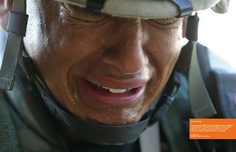
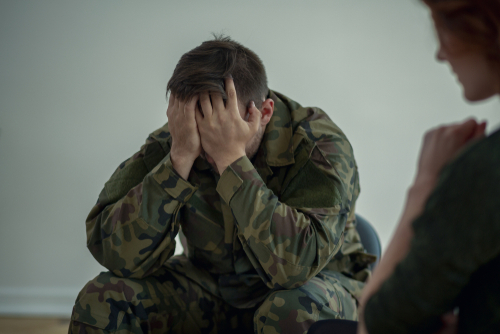
Veterans face a tough road with grief, anxiety and PTSD. The things soldiers see in war is sometimes traumatic and scarring to the individual soldier. Many soldiers do not receive the help they need. Instead they face many issues alone. It is important for them to meet with others, discuss and review traumatic events.
Soldiers face trauma and loss possibly everyday and have to deal with their entire life. Please also review our Grief Counseling Certification
The article, “7 WAYS GRIEF AFFECTS VETERANS” by Pat Harriman states,
“Researchers determined levels of grief, including preoccupation with a lost comrade and inability to accept the loss, through participants’ self-reported combat exposure, unit cohesion, PTSD symptoms, anger, past post-traumatic stress syndrome and depression diagnoses, and pre-deployment life events.”
Grief counselors and other specialists can help work with soldiers face these issues. There are so many issues under laying trauma that need to be exposed and discussed for proper healing. Please also review our Grief Counseling Certification.
Some individuals while coping through grief deal with difficulties in overcoming the grief due to various thoughts that surround the death or incident. Trying to escape these thoughts can become exhausting emotionally. Whats Your Grief refers to these as stuck points, when someone is unable to move past a certain aspect of the loss.
Usually these points challenge pre-conceived notions or values. The loss makes the griever doubt these notions and prevents them from moving forward but keeps them constantly stuck, re-tracking and falling prey to those thoughts. This is very detrimental to the grieving process and coping
PTSD and other problems can make individuals stuck in grief due to thoughts that prevent coping and advancement in the grief process
The article, “What are Stuck Points in Grief?” from Whats Your Grief states,
“Stuck points refer to thoughts that repeatedly bubble up in a person’s inner (and outer) dialogue that make it difficult for a person to process, cope with, or reconcile their experiences. To me, stuck points are like mean old trolls living under a bridge. Whenever a person tries to gain some momentum in working through their experiences, the troll comes up and says “Nope, you can’t pass. Now go back and think about what’s happened.”
Another type of stuck point is a religious view some may contend with. Many pray to God for cures or good things to occur. The problem is sometimes that cure does not occur. Bad things do happen to good people.
This can create a complex within someone that creates a religious paradigm within the individual. While coping with grief and loss, they may constantly turn back to “Why did God do this to me?” or “Were not my prayers good enough?”
In addition to this, others may begin to see their loss in a form of religious struggle. If God is good how can he allow this evil? Or if God is good, then he must not be All Powerful to allow this evil?
These spiritual dilemmas are a result of primitive understanding of faith. First, prayer is not contract. When prayer is seen as contract, it fails to meet the relationship that exists. A covenant of mutual care not necessarily answers that we demand if we do this or that.
Second, God is All Powerful and All Good, but he has given free will to others. This permits evil. One can also not see the over all view of existence within our temporal realm.
Loss can challenge preconceived notions of life and the universe, as well as previously held religious and spiritual beliefs. This can cause intense anxiety during the grief process
The article also does a good job at looking at other world views that are not religious. The ideal of the world being a safe place when violence occurs to a loved one can have long lingering effects.
Grief is difficult enough to deal with. Coping with a loss can be difficult but when certain ideas regarding that loss start to affect one’s coping and emotions, then they need to be analyzed and understood. As the article states, one should document in a diary how common these thoughts are and relate them to reason as opposed to emotion. If necessary, talk about these thoughts and try to get passed them.
If you would like to learn more about Grief Counseling, then please review our Grief Counseling Program and see if it matches your academic and professional goals.
The program is a home study program. It is online and self paced. As an independent study program you go at your own pace. After completing the required four courses, you can proceed to apply for certification. Certification is four years and can be renewed as needed.
Grief can become a difficult thing in life. It can scar one forever but it can also take control of life if one is unable to properly cope with its elements. Learning to embrace grief and what comes with it is the best strategy instead of trying to avoid it and not express. Repression creates a bigger grief monster.
Coping with grief and finally finding joy in what was once is a difficult step in recovery. Please also review our Grief Counseling Certification
The article, “Taming the Grief Monster” by Linda Zelik looks at when the joy of possessing what was lost eventually overtakes the pain of losing it. In particular the tragic loss of a child. She states,
“Traversing this path of profound grief may be the most difficult thing you ever face in life. Unfortunately, there are no magic wands or quick fixes. How could there be? A parent’s love for their child is total and unconditional, unlike any other kind of love. Even if we didn’t always like their actions or choices, our children held our love and it never wavered.”
Many women while pregnant experience a variety of emotional swings. Depression unfortunately is not an exception to what an expecting mother may go through during pregnancy.
Depression can occur for women during and after pregnancy. Please also review our Grief Counseling Certification and see if it meets your academic and professional goals
The article, “Pregnant and Depressed” by Joanna Novak looks into how depression can affect pregnant women. In addition to depression during, issues also can arise afterwards. She states,
“Fifteen percent of women will suffer from depression following childbirth—and some of those cases could be prevented by catching depression that starts during pregnancy. What’s more, depression, like any other medical condition, comes with risks for the fetus as well as the mother. ”
Miscarriage may seem invisible to many but it is a reality that can affect a couple or woman. The expectations and joy of what if can all be lost in a miscarriage. The lost of a life whether born or not yet born may be less visible but it is still a real loss of a child. The loss of a child takes away the status of motherhood or fatherhood potentially to individuals.
Miscarriages represent true loss. Many parents suffer without any consolation. Please also review our Grief Counseling Certification
The article, “Early Miscarriage Is An Invisible Loss, But The Grief Is Real” discusses this loss. Beth Bailey states,
“There was nothing chemical about the pregnancy my body briefly nurtured. Its effects may have been invisible to those around me, but the child was real and much desired. The loss was greatly mourned.”
This type of loss is common but rarely acknowledged as true loss for many. To read the entire article, please click here
Please also review our Grief Counseling Certification program and see if it matches your academic and professional goals
After a miscarriage so many emotions can erupt. For some relief but with that relief possibly guilt. Some may also mourn the loss and feel extreme sadness and anger. These emotions are natural with such a close loss to one’s self. Miscarriage loss is something that is many times swept to the side but is indeed a big loss with multiple emotions that can interact in strange ways.
Miscarriage is a big loss for many women. Numerous emotions surround it. Please also review our Grief Counseling Certification
The article, “After a Miscarriage, Grief, Anger, Envy, Relief and Guilt” by Jessica Grose stated,
“October is pregnancy and infant loss awareness month, and if your family has experienced any kind of loss, we are here for you. Miscarriage is common — as many as 15 percent of known pregnancies end in a first-trimester loss.”
Dealing with grief especially after the loss of a child in womb or out is a difficult thing to deal with. Sometimes grief counseling is needed to help others overcome these type of miscarriage losses. Please also review our Grief Counseling Certification
Grief is pivotal, central and important emotion in human life. It is forever tied to the fallen human condition and deeply connected to the emotion of love. Grief is more than just a sentient emotion but an emotion felt in many animals as well. Hence grief is beyond intellect but also instinctive and evolutionary.
Individuals do consciously grieve and understand the loss but grief also is a natural reaction to loss at the most simple level. Grief as a formula is simply put love plus loss equals grief. Love is a binding emotion. Love ties one to another person or thing. Through value of the possessed and habit of possessing, anything that removes that love or thing causes discomfort. This discomfort is grief.
Grief is a healthy and natural reaction to loss. It helps one adjust to loss and adjust to the change that comes with losing something or someone we love
The grief reaction to loss varies and is correlated to the value of the loved person or thing. If something has little value, then the loss is inconsequential. If something or someone has great value in in one’s life, then the loss is very consequential. Some losses can be small and insignificant while other losses can be life altering. The greater the loss, the greater the grief.
The loss may be objective or subjective in value according to the person. Someone who was raised by his or her grandparents will grieve the loss of a grandparent more than someone who only saw his or her grandparents once a year. Loss can also be subjective in that is may seem odd to others. For example, some may find it extremely odd to mourn the loss of a pet, while pet owners would disagree completely. Again the subjective value is key in understanding the loss reaction.
While grief in many ways is abides by universal standards and reactions, one must also realize that the reactions within this wide norm differs extremely. So while grief is universal it is still unique.
Grief as stated is not only a conscious pain but also a unconscious reaction. The grave importance of grief is to help the person or animal adjust to the loss. The adjustment process is a long mourning period where one learns how to cope without the person or thing. Most non complicated grief reactions to significant loss lasts six months to a year before it becomes labeled as pathological or complicated. This does not guarantee that grief goes away within a set time, but it does illustrate that new coping strategies are incorporated into the person’s life to better deal with the loss on a day to day basis.
Grief allows one’s mental self to heal. It permits the body to mourn and adjust to loss. Long ago this natural adjustment and self healing was considered a pathology in itself but psychology now teaches that grief is an important transitional ingredient in healing. It should not be dismissed or rejected but fully accepted as a normal and healthy reaction to loss. Seeing grief as something bad or unhealthy is a dangerous view to hold. Grief instead is the body reacting to loss and learning to adjust to that loss in a more healthy way. Complete adjustment is a simple lie. This is the price of love. Anything worth loving is never worth forgetting or missing but grieving allows our mind to heal and learn to exist differently.
Grief hence has a very important function in healing but grief is also a social sign to others. In animals especially, signs of grief permits other members of the community to help the grieving animal to recover. The same social signs of grief, tears, crying and emotional withdraw signify to family and friends that one needs help. Grieving hence serves a signal to the community to help those who are sad or depressed. It is a social subconscious distress symbol to family and friends.
Grief because of this is not something bad. Losing something or someone is bad but the reaction to it is not bad. If there was no reaction to loss, then one would be merely a non sentient creature merely existing from meal to meal. Instead, the reaction to loss not only serves as a healthy reaction to loss that leads to recovery, but it is also a sentient reaction to something or someone that was very special.
It allows one to heal and alert others of distress but it forever reminds one the value of what was lost. It never allows one to forget the beloved and the love that was shared. This grief becomes part of who we are the moment we enter into love or deep communion with another human being. If one did not grieve, then what value is that relationship? Grieving is important in identifying what mattered most and not allowing what mattered most to be ever forgotten.
Grieving in its later stages, pushes individuals to healthy coping measures where acute depression is replaced with action. Memoralizing and living a certain way in honor of the beloved becomes healthy and conducive expressions of grief. In national losses, social action for better laws or prevention of future loss are a result of healthy coping produced through grief. Grief hence is an important emotion in being human and living a healthy human life.
Avoiding grief can lead to complications. We need to accept grief and realize it is price of love. Please also review our Grief Counselor Program
Suffering and loss are products of an imperfect world. Those of faith pray and hope that the next world will have no suffering and loss. They pray that grief will only be a necessary emotion in the temporal world and not the after life. In this, those of faith can cope even better than those of no faith. The reality regardless of faith though is that one must escape and embrace grief while in this world if they wish to cope and live a healthy life.
Certified grief counselors can help individuals cope with grief and embrace it a healthy way. Change is never an easy thing but through help, one can utilize grief to better adjust and adapt to loss. The American Academy of Grief Counseling offers a comprehensive program in Grief Counseling. Certified grief counselors learn the basics of grieving and are trained to help others. Beyond the basic Grief Counseling certification, members and qualified professionals can also specialize in Child and Adolescent Grief Counseling, Pet Loss Grief Support, and Christian Grief Counseling.
The programs are online and independent study. After completion of the online program, one can become certified for four years. If you are interested in learning more about the American Academy of Grief Counseling’s certification program then please review the program and see if it matches your academic and professional goals. Once certified as a Grief Counselor, you can then become able to help others face grief in a healthy and natural way.
Grief that is not processed or acknowledged can cause long term mental issues. Complications in grief are due to not facing grief and processing the loss in a healthy fashion. When we purposely ignore our feelings due to loss, we open ourselves to greater damage down the road. Grief is part of healing and is essential to adjusting to the loss in a healthy fashion. If we do not grieve, we will suffer more. Acknowledging grief is an essential ingredient to recovery.
One must accept the grief associated with their journey in life. Please also review our Grief Counseling Certification and see if it meets your academic goals
One cannot dismiss emotion due to shame or fear of weakness, but realize that anything worth love is also worth grieving over.
The article, “The Grief We Avoid Is The Grief That We Need” by LaLaine Dawn looks at how grief is important and essential to the very reality of living. She states,
“A lot of us are so afraid to admit we are grieving for fear that people may see us as weak or stupid for feeling that way. Honestly, I can’t blame you. In my experience, there were people in my life who would laugh at my grief. They would tell me I deserved to suffer.”
To read the entire article, please click here
Grief is hence an important element of the human condition. It cannot be ignored but must be acknowledged and dealt with. To learn more, please review our Grief Counseling Certification and see if it meets your academic and professional goals.
Grief is a natural reaction but over time it can become complicated. Grief that does not adjust to loss but becomes toxic requires assistance. Counseling can help but sometimes treatment is also needed. Licensed professional counselors can help with this but usually a simple certified grief counselor can help someone learn to cope with the grief in a healthy way.
When has your grief become complicated and no longer just a normal reaction to loss? Please also review our Grief Counseling Certification
The article, “Here’s When It’s Time to See Someone About Your Grief” by Patia Braithwaite states,
“As awful as it feels, grief is a natural human response to losing someone close to you. The intense emotions that come with grief can all be an appropriate part of eventually helping you heal as much as possible. But there are times when grief is even more overwhelming than usual—times when it hinders your life and happiness long-term”
Complicated grief can become a big issue if not treated. Please also review our Grief Counseling Certification and see if it meets your academic and professional goals.
Grief is a reaction to loss. It is natural but overtime grief can become toxic to the body. Long term and pathological grief can weaken the body and affect it negatively. This is why it is important to ensure you are grieving in a healthy fashion. If not, one should seek help and counseling.
Long term and pathological grief can negative effects on health. Please also review our Grief Counseling Certification
The article, “How Grief Shows Up In Your Body” by Stephanie Hairston looks at the negative effects of adverse grief in one’s life. She states,
“What causes these physical symptoms? A range of studies reveal the powerful effects grief can have on the body. Grief increases inflammation, which can worsen health problems you already have and cause new ones. It batters the immune system, leaving you depleted and vulnerable to infection. The heartbreak of grief can increase blood pressure and the risk of blood clots.”
To continue reading, please read the entire article by clicking here