
Christ is born! Glorify Him!
In this blog, we are going to see the critical and central importance of the Incarnation to Christian theology and human salvation found in Christmas. The power of John’s monologue that leads to the famous words “And the Word became Flesh” are central to the faith and are powerful reminders of God’s love for humanity which He never intended to forsake due to the sin of Adam. In fact, the Incarnation is the most singular act of love ever in history. Instead of being an absent God from a distant throne, God chose to get into the mud with His creation and save it.
Please also review AIHCP’s Christian Counseling Certification.
What is the Incarnation?
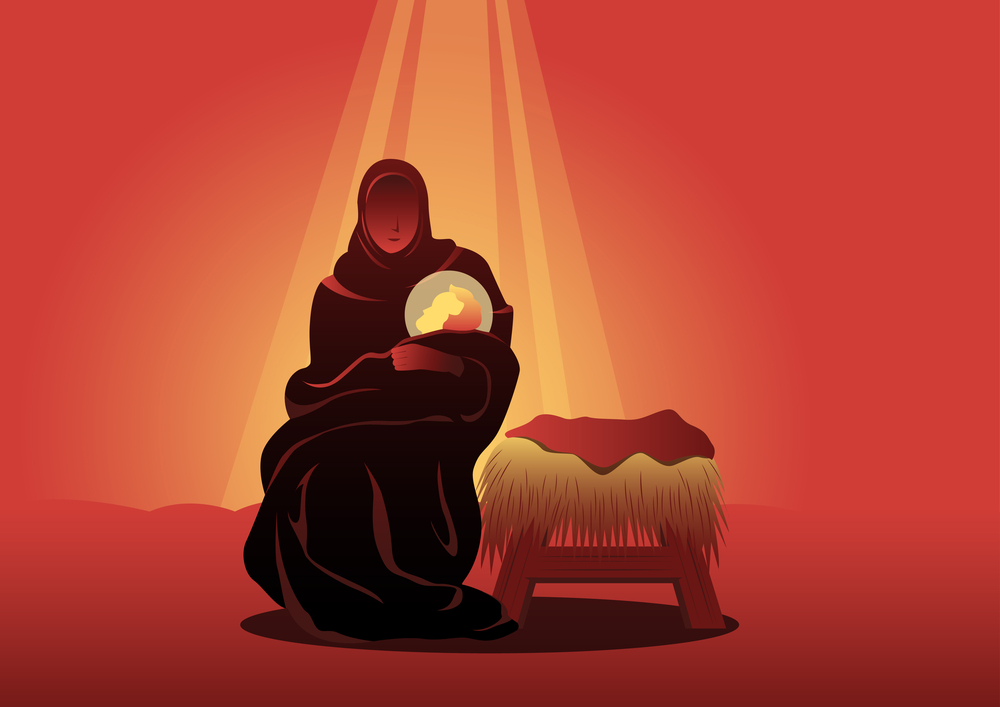
While the Incarnation is the most central aspect of the Christian faith, it is a mystery that is hard to understand or even believe for those outside of the faith. Whether religious within a different tradition, or secular, it seems almost impossible that a human being can be God. For many, it screams the same ancient stories of Hercules, half god and half man, or as if gods with more human qualities procreate with women under the guise of regular person. This crude analogy to the Incarnation of Jesus Christ does not compare or even capture the true meaning of the Incarnation.
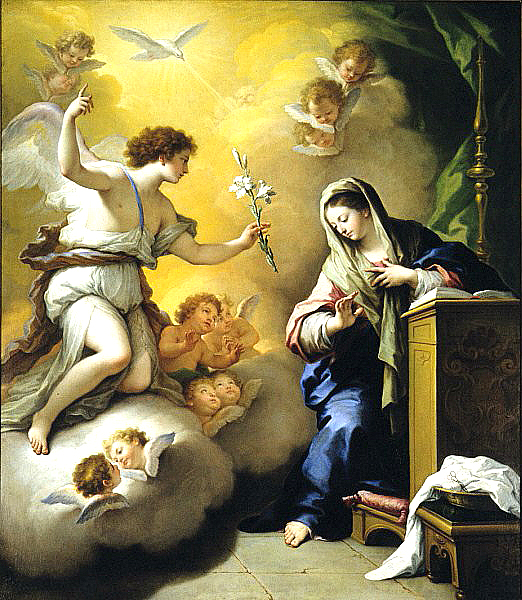
Mary said yes at the Annunciation in Luke’s Gospel and with that yes, a miracle occurred. Mary, herself, became the new Ark of the Covenant, a covenant far greater than that of Moses and law, but a new covenant of salvation with Christ. Mary’s willingness to say yes to God allowed an infinite being to enter into time. The Holy Spirit miraculously permitted Mary to become a mother yet also retain her virginity by infusing into her womb, the Second Person of the Trinity and the complete personhood of the man, Jesus Christ. She “knew” not any man but yet had conceived. Upon her yes, an angel was sent to inform St Joseph, her betrothed and the foster father of Jesus, that Mary had committed no sin and that but God had granted the world a great miracle and its Messiah. Joseph, like Mary, said yes. Mary and Joseph both played key roles in the Incarnation and through their obedience and humility, Christ entered into the world. Jesus would become the new Adam and his mother would become the new Eve. Where Adam and Eve said no to God, Jesus and Mary would say yes to God
But beyond the story of Christ’s birth in a stable and the coming of the shepherds and wise men, there is a deep theology which while unable to explain how the impossible can occur due to its mystery, still nonetheless explains what is to be believed and why. The theology of the Incarnation first speaks about the reason behind the miracle. There are two primary reasons for the purpose behind the Incarnation. First, it was necessary. The fall of Adam and Eve left humanity in the darkness of the world. Adam entered into a new temporal reality that stripped him of his supernatural gifts of knowledge and control of the passions and instead granted him suffering, hard work and death. Beyond these physical manifestations, his fall also left humanity without grace and marked with Original Sin. A grave injustice and imbalance emerged which left humanity severed from God’s grace and parenthood. Instead, the power of Satan overtook the world and humanity was locked away from grace and divine paternity. The solution required a sacrifice of penance and reparation for the wrong. It required a spotless and perfect priest to offer a spotless and perfect victim or sacrifice. No human was perfect and no sacrifice could ever match the injustice done to God via Adam’s sin. Hence out of necessity, God became flesh to not only be our priest but to also be our victim of sacrifice. The second reason behind the Incarnation is theoretical but championed by many theologians, saints and mystics. It is believed that God always planned to take upon human nature to better connect and love us, but to also elevate His creation of humanity. It is speculated that this plan of elevated human nature to such status was one of the primary reasons Lucifer rejected God. Out of pride, Lucifer resented that something so human could ever be made greater than his own angelic self. Upon this he rebelled, was cast to Hell and forever determined to mock and destroy humanity.
Understanding the Incarnation
As a mystery of faith, the Incarnation cannot be completely explained, nor can rationale or science confirm it, but through philosophical reasoning, an understanding of the fall, and God’s infinite mercy, one can come to coherent system of thought within the narrative of the fall of Adam. Within this narrative, the necessity of God/man is essential. The Incarnation answers the challenge of the fall of humanity and gives humanity redemption. The Incarnation, even without the passion of Christ, would have sufficed for humanity’s salvation. One simple chill to the new born Christ, or even a cry of hunger to His mother would have been alone suffice to redeem humanity, but the price of sin, the evil side of humanity and the vengeance of Lucifer demanded more. And like Mary and Joseph, Jesus said yes to God.
The Incarnation while mysterious is not hard to describe or illustrate. In essence, the Second Person of the Blessed Trinity, the Word or Son, took upon a human nature. In this way, God entered into time and the temporal realm as a person. Due to many ancient heresies regarding the nature of Christ as both God and man, many theories and confusions arose. Most heresies either combined Christ’s human nature and divine nature into a messy personhood that is truly neither (Monophysitism) or separated the natures to such an extent that Christ appeared as two persons (Nestorianism). These and other heresies regarding Christ were condemned at early Church councils such as Ephesus or Chalcedon.
So, the Incarnation is not about fusing two natures into one nature, or separating two natures creating two persons, or even the body of Jesus being a shell for the Divine, or the body being a mysterious phantasm, but the Incarnation teaches, as Pope Leo I declared at Chalcedon, two complete natures, one person.
If dissecting this, it means Jesus is both God and man, perfectly complete. It is not a 50/50 mix but a 100/100 fusion of two complete natures into one person. At the moment of Christ’s conception in the womb of Mary, Jesus’ human nature was created and at that exact moment, the Word entered into the body of Christ. There was never a moment that Jesus human nature was without the divine nature. There was not a preliminary moment for Jesus to accept His divinity for it was always there within His very essence of creation. Yes, the Divine nature was eternal and existed before time and the human nature was created in temporal time, but the moment the conception occurred, Jesus was both God and man perfectly. Jesus had a body and yes, even His own soul. Many Christians some time forget this amazing aspect of the Incarnation. Jesus had two wills since He had two natures but the wills were perfectly aligned within one person and working in perfect harmony. Sometimes in Scripture, Jesus says things that are very human, but also at times says things that are very divine. We can see when Christ’s humanity shines bright and in other cases when His divinity shines bright throughout His life in the Gospels. As a man, Jesus could suffer, albeit not due to sin, for He was made like us in everything but sin, but He still permitted Himself to be subject to the pains of the temporal world. But as God, Jesus was able to perform miracles and manifest Himself to the Apostles at the Transfiguration. So when we study scripture, we find many samples of emphasis on humanity but also many points that direct to His Divinity. To the untrained eye, this can seem as contradictions, but it is merely the reality of Jesus being both completely God and man.
Conclusion
The Incarnation is a story of love. The perfect gift of self. God, through the Second Person, took upon a human nature of Jesus, retaining His divine and sharing in complete possession of the human. It is because of this that Christ is both God and man. This is why we worship Jesus Christ because within this singular person is both Jesus and the Second Person, perfectly united as one person. This is indeed mysterious, but is also the faith!
Please also review AIHCP’s Christian Counseling Certification
Additional Resources
“What Is the Incarnation?” (2007) Desiring God. Access here
Moran, M (2024). “Christian Counseling Education: The Incarnation: Divinity on Earth”. Access here
“The Incarnation of Jesus Christ: Purpose and Meaning for Mankind” (2023). Christianity.com. Access here
“Incarnation”. Catholic Answers. Access here