
 Written by Melanija Dubra,
Primum non nocere is under 200 years old, and the first book to put it in print credited the wrong physician. That mistake matters: the real test of “do no harm” isn’t the operating room, it’s how surgical instruments are cleaned between patients, and what happens when that fails.
Most people picture it in the operating room, in the surgeon’s hands. In practice, it sits in the room down the hall, where used instruments are cleaned before they touch the next patient. That is the argument this piece makes.
Where Does “Primum Non Nocere” Come From, and What Does It Actually Mean?
In 2005, pharmacologist Cedric M. Smith searched medical writing back to the Middle Ages for the phrase’s origin. He found it in neither Hippocrates nor Galen. Its first appearance in print was in an 1860 book by the English physician Thomas Inman. Inman credited the line to Thomas Sydenham, a doctor who had died in 1689, but Sydenham never wrote it either. So the phrase was misattributed from the start, and it spread anyway.
It is not in the Hippocratic Oath. The closest genuine ancestor appears in a different Hippocratic text: in Epidemics, Book I, physicians are instructed to keep two goals in view:
- to help,
- or at least to do no harm.
The idea is authentically ancient. The Latin slogan is a Victorian invention.
Why Is Instrument Sterilization Where “Do No Harm” Gets Tested?
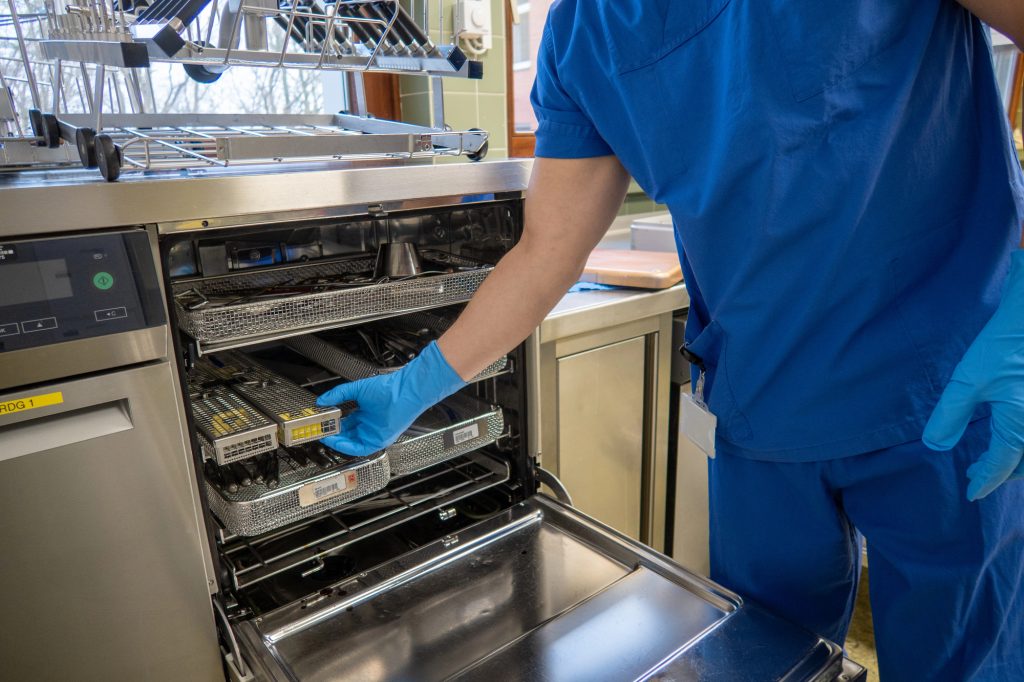
“Do no harm” is not a decision made once, at the moment of surgery. It applies to every step of care: before, during, and after the procedure. One of those steps rarely gets attention: reprocessing. This is the cleaning, disinfecting, and sterilizing of instruments that get reused, sometimes dozens of times a day.
It is also the step patients never see. The work is repetitive, done by technicians the patient will never meet, and it happens fast, between one case and the next. When something goes wrong here, it is rarely because someone was careless. It is because the process asks for the same level of care every single time, with no room for a bad day. One serious eye complication, tracked across six years of investigation, shows what happens when that slips. It is worth walking through in full, because it shows exactly how the standard gets tested, and how quietly it can fail.
Toxic Anterior Segment Syndrome: What Happens When Reprocessing Fails?
Toxic anterior segment syndrome, or TASS, is a severe inflammation inside the eye that usually develops 12 to 48 hours after cataract surgery. It is not an infection but a toxic reaction to a substance that got into the eye during surgery. Because it looks so similar to a real infection, it’s often misdiagnosed and treated as one, and either way the patient spends the following days afraid of losing the eye.
After a cluster of outbreaks in 2006, ASCRS formed a TASS Task Force to find the cause. Between 2007 and 2012 it examined 1,454 TASS cases drawn from roughly 69,000 cataract surgeries performed at surgery centers that had already reported problems. That denominator matters: it is the caseload of affected centers under investigation, not a national rate.
In ordinary practice TASS is far rarer, estimated at roughly 1 in 1,000 cataract surgeries, and measured at 0.22% in one series of 26,408 consecutive cases. So the task force figures are not a measure of how often TASS happens. They are a detailed view of why it happens.
Few of these patients were harmed by a surgeon’s technique. In most cases the harm came from something that happened to an instrument between one patient and the next.
The Everyday Mistakes Behind Most TASS Cases
The task force found three causes behind nearly all the cases. None involved negligence, only a lapse in an already demanding routine.
Instrument Residue Left to Dry
Blood, tissue, and the gel used in cataract surgery must stay moist until cleaning begins. Once that gel dries inside a phaco handpiece’s narrow channel, scrubbing the outside won’t remove it, and it won’t be visible on inspection. Using the right cleaning brush size matters as much as timing: a brush that doesn’t match the channel can’t do the job.
Detergent and Water Quality Left Unverified
Enzyme detergents can leave residues that steam doesn’t destroy. Tap water used for the final rinse adds another risk, since it can carry bacterial endotoxin that an autoclave won’t remove. Sterile does not mean free of toxins. That gap is what the ANSI/AAMI ST108 water standard addresses, by setting which water grade to use at each step.
Conflicting Instructions on the Same Tray
One tray often holds instruments from several manufacturers, each with different cleaning instructions. Sorting them out under time pressure isn’t always realistic. It’s why ASCRS recommends buying instruments, sterilization equipment, and cleaning equipment from suppliers who publish clear instructions for every item.
It’s a common problem, too. Reprocessing shows up often among The Joint Commission’s top-cited issues, and the CDC is clear that sterilization only works once all residue is fully removed.
What Does Proper Surgical Instrument Reprocessing Look Like?
A tray sterilizes nothing on its own. The instructions for the instrument, the tray, and the sterilizer all have to match. A tray can’t make a cycle compliant by itself, but a bad one can stop the cycle working at all. This is the same logic ANSI/AAMI ST79, the comprehensive U.S. standard for steam sterilization reprocessing, is built on: the instrument, the tray, and the sterilizer are treated as one connected system, not separate steps.
Instruments touching each other block steam and can damage fine tips. A solid-bottomed container traps water that needs to drain. An overloaded tray dries slowly, and a damp load coming out of the autoclave counts as contaminated, no matter how long the cycle ran.
A good tray also makes inspection possible: fine tips and box locks need to be checked under magnification, which is hard to do when instruments are piled loosely in a pan. In practice, that means using trays built to hold instruments apart through the whole cycle, not just any container the instruments happen to sit in.
Seven Questions Every Sterile Processing Team Should Be Able to Answer
A quick assessment for any reprocessing department:
- How long passes between an instrument leaving the field and cleaning starting, and is it kept moist throughout?
- Is an enzyme detergent used because the manufacturer’s instructions require it, or because it was assumed to be necessary?
- What water is used for the final rinse, and has it been verified against current standards?
- Is every load fully dry before it enters storage?
- Could a technician produce the cleaning instructions for every instrument on a given tray within five minutes?
- When was an unused instrument last removed from a tray?
- If a lapse were identified tomorrow, could the affected patients be traced?
None of these questions require new equipment. They require a department that asks them routinely.
Do No Harm Is a Daily Standard
Thomas Inman attributed the phrase incorrectly in 1860, and it survived the error because it described something true.
Under two hundred years is not a long history. Primum non nocere was never an inheritance the profession only had to preserve. It is a standard that must be met again every day, largely by people the patient never meets.
Behind a successful surgical outcome is often a technician who rinsed a handpiece for the correct duration, examined instruments under magnification, and reconciled conflicting manufacturer instructions before the next case began. That work is not peripheral to “do no harm.” It is where the standard is actually decided.
About the author
Melanija Dubra is a content creator who writes about health, wellbeing, and clinical practice. She’d rather read the original study than someone’s summary of it. Wellbeing is something she genuinely cares about, so getting the details right feels like part of the job rather than an extra step.
References
American Society of Cataract and Refractive Surgery, American Society of Ophthalmic Registered Nurses, American Academy of Ophthalmology, & Outpatient Ophthalmic Surgery Society. (2018). Guidelines for the cleaning and sterilization of intraocular surgical instruments. Journal of Cataract & Refractive Surgery, 44(6).
Centers for Disease Control and Prevention & Healthcare Infection Control Practices Advisory Committee. (2024). Guideline for disinfection and sterilization in healthcare facilities, 2008 (updated June 2024). U.S. Department of Health and Human Services.
Chaudhry, S., & Sharma, N. (2024). Toxic anterior segment syndrome (TASS): A review and update. Indian Journal of Ophthalmology, 72(1).
Smith, C. M. (2005). Origin and uses of primum non nocere – above all, do no harm! Journal of Clinical Pharmacology, 45(4), 371-377.
The Joint Commission. (2024). Infection prevention and control requirement IC.02.02.01, element of performance 2: most frequently cited findings, 2021-2024. The Joint Commission.
Sengupta, S., Chang, D. F., Gandhi, R., Kenia, H., & Venkatesh, R. (2011). Incidence and long-term outcomes of toxic anterior segment syndrome at Aravind Eye Hospital. Journal of Cataract & Refractive Surgery, 37(9), 1673-1678.
Please also review AIHCP’s Legal Nurse Certification program and our CE courses as well, to see if they meet your academic and professional goals. These programs are online and independent study and open to qualified professionals seeking a four year certification