
 Written by Shivam Pujara,
Most clinicians think about prior authorization at intake. In behavioral health, the more common problem shows up later. The authorization approves a set number of sessions or units over a set date range, treatment continues, and at some point the care being delivered is no longer covered by an active approval. Nobody notices until the claims come back denied.
In our audit of 61,400 claims from January 2025 to June 2026, missing or invalid prior authorization caused 17% of denials. This article explains how behavioral health authorizations are structured, why they lapse in the middle of treatment, what clinicians can document to support continued care, and how new federal rules change the timelines for some payers.
How behavioral health authorizations are structured
An outpatient behavioral health authorization usually approves three things together: a service or level of care, a number of sessions or units, and a date range. An approval might cover 12 psychotherapy sessions between March 1 and May 31, or a set number of hours per week of a structured program. Higher levels of care, such as intensive outpatient or partial hospitalization programs, are often approved for shorter periods and reviewed more often.
Continued care after the approval runs out typically goes through concurrent review. The payer looks at the clinical record and decides whether further treatment at the same level of care is medically necessary. If it is, a new authorization is issued with its own units and dates.
Behavioral health coverage also adds a routing question. Many health plans carve out mental health and substance use benefits to a separate behavioral health organization, which handles both authorizations and claims. An authorization requested from the medical plan instead of the carve-out vendor does not protect the claim. In our audit, claims sent to the medical plan instead of the behavioral health carve-out caused 12% of behavioral health denials.
Why authorizations lapse in the middle of treatment
A lapse rarely comes from one missed step. It usually comes from a change that nobody connected to the authorization:
- Session frequency increased. A client moves from weekly to twice-weekly sessions during a crisis, and the approved sessions run out weeks before the end date.
- The date range ended first. Sessions were missed or rescheduled, and the approval expired with units still unused.
- The level of care changed. A step up to an intensive program, or a step down to standard outpatient care, usually needs its own approval.
- The coverage changed. A new plan year, an employer plan change or a Medicaid redetermination means the old approval no longer applies.
- The treating clinician changed. Some payers tie an approval to a specific rendering provider, so a handoff inside the same practice can leave sessions uncovered.
The pattern is clearest in services billed by the unit. In applied behavior analysis, authorization unit overruns caused 29% of ABA denials in our audit. The same mechanics apply to any service where the approval counts units and the schedule can change faster than the approval does.
Outside behavioral health the pattern repeats: lapsed biologic re-authorizations caused 31% of GI infusion denials.
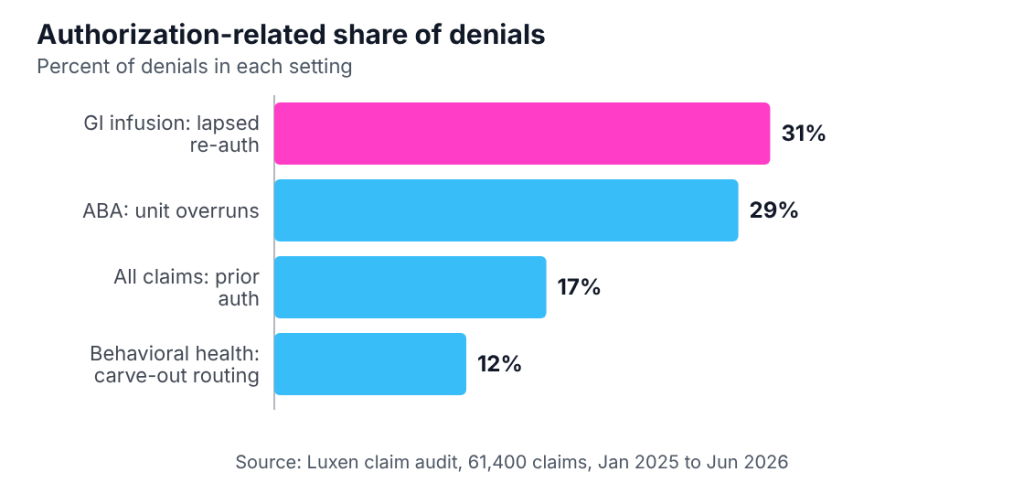
Figure 1. Authorization-related share of denials in each setting. Source: Luxen claim audit, 61,400 claims, Jan 2025 to Jun 2026.
What the timing looks like in practice
The window for requesting a renewal is shorter than it looks, because the payer’s review takes time. In our client data, ABA re-authorizations took a median 12 business days, about two and a half calendar weeks.
Take a client approved for 12 sessions who moves to twice-weekly sessions. The 12 sessions are used up in 6 weeks. If the renewal takes 12 business days to come back, the request has to go in early in week 4, after about 7 sessions, for the new approval to be in place before session 13. A practice that waits until the last approved session to submit will deliver four or five sessions with no active approval behind them.
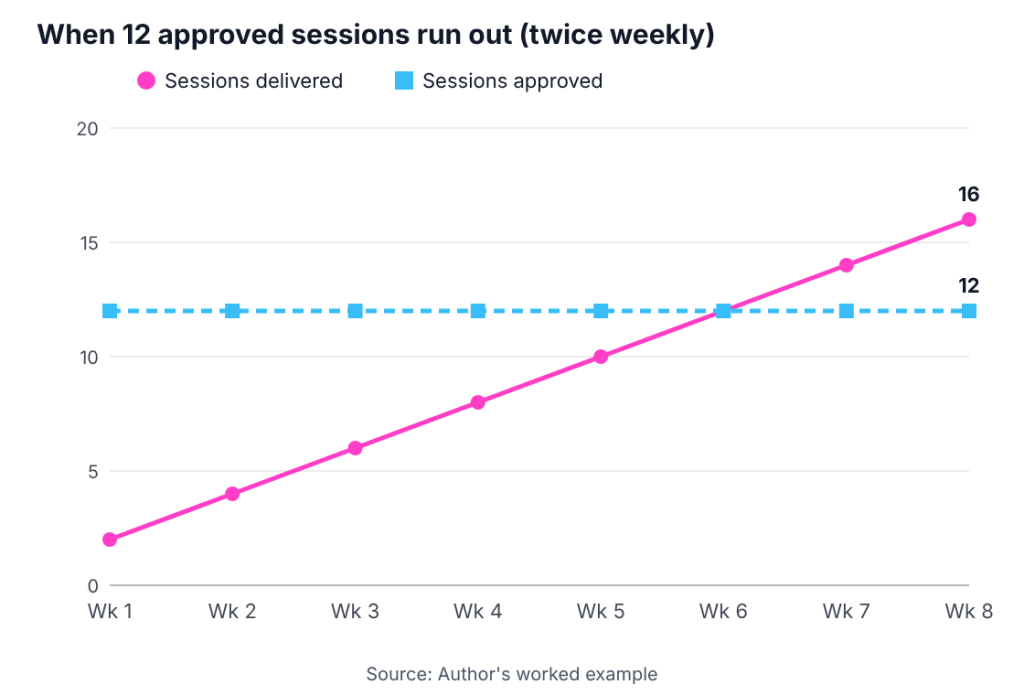
Figure 2. When 12 approved sessions run out, with a client seen twice weekly. Source: author’s worked example.
This is why a fixed trigger works better than memory. Many practices request renewal when a set share of units has been used, or a set number of weeks before the end date, whichever comes first, with the trigger adjusted for each payer’s turnaround.
What clinicians can document to support continued care
Concurrent review decisions are made from the record, so the clinician’s notes carry most of the weight. Reviewers generally look for:
- The current diagnosis and how symptoms present now, not only at intake.
- Measurable progress toward treatment plan goals, including results from standardized measures where the clinician uses them, such as the PHQ-9 or GAD-7.
- The reason continued treatment at this level of care is needed, including risk factors and what is likely to happen if care stops.
- An updated treatment plan with goals, frequency and expected duration.
- A discharge or step-down plan that shows where treatment is heading.
Notes that repeat the intake picture, or that describe sessions without linking them to goals, make medical necessity harder to show. The reviewer needs to see why care is still needed now.
How federal rules changed authorization timelines in 2026
The CMS Interoperability and Prior Authorization Final Rule (CMS-0057-F) set decision deadlines for several types of payers starting January 1, 2026. Medicare Advantage organizations, state Medicaid and CHIP fee-for-service programs, Medicaid managed care plans and CHIP managed care entities must decide expedited requests within 72 hours and standard requests within seven calendar days. They must also give a specific reason when they deny a prior authorization request, and publicly report prior authorization metrics each year, starting March 31, 2026.
The rule does not cover employer-sponsored commercial plans or Qualified Health Plans on the Federally Facilitated Exchanges, and its provisions do not apply to drugs. For commercial plans, turnaround times still depend on the plan and on state law, so renewal triggers need to allow for longer reviews.
What happens when an authorization lapses anyway
Sessions delivered without an active approval are usually denied. Some payers allow a retroactive authorization request within a short window, and a denied claim can be appealed with the clinical record that supports medical necessity. Both depend on acting quickly.
Across our audit, the leading causes of denials were eligibility and coverage errors (24%), coding and modifier errors (21%), missing or invalid prior authorization (17%), duplicate claims (9%) and timely filing (6%).
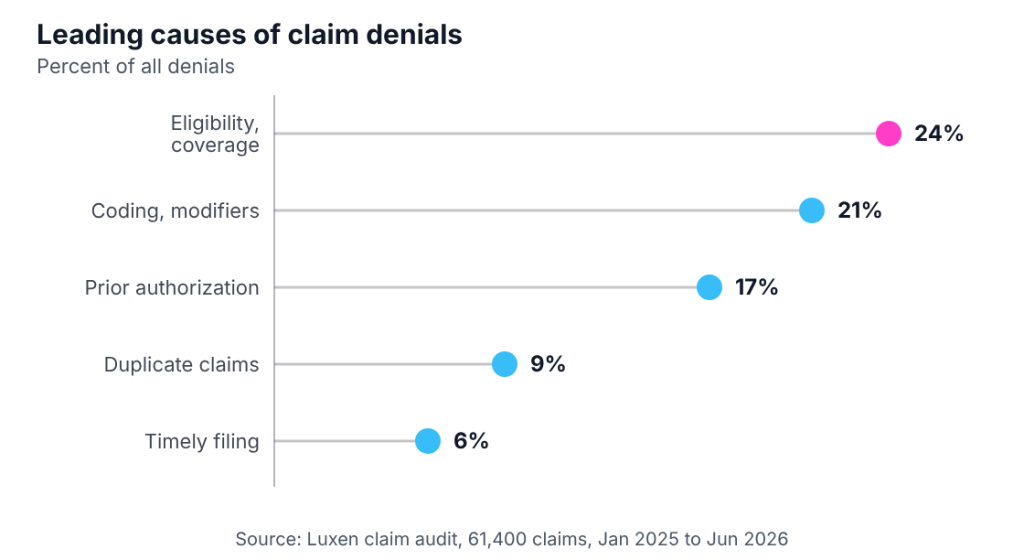
Figure 3. Leading causes of claim denials, as a percent of all denials. Source: Luxen claim audit, 61,400 claims, Jan 2025 to Jun 2026.
Delay makes recovery much less likely. Timely filing caused 6% of denials, and only 4% of those were recovered. In our billing reviews, 19% of denied claims were never reworked or appealed. We have written separately about reading denial reasons and deciding which claims to appeal.
Who should own authorization tracking
Authorization lapses often fall between roles. The clinician knows the treatment plan has changed, the front desk schedules the sessions, and the billing team sees the denial weeks later. In our survey of 286 practice managers, 42% said nobody owns denial follow-up full time, and practice managers estimated 11 staff hours a week on insurance calls and portal checks.
A shared tracker closes most of the gap. At a minimum it should hold:
| Field | Why it matters |
|---|---|
| Payer and authorizing entity | Confirms the request went to the carve-out vendor if one manages the benefit |
| Service or level of care | A change in level of care usually needs a new approval |
| Units approved and units used | Shows how fast the approval is being used, session by session |
| Start and end dates | Catches approvals that expire before the units run out |
| Rendering clinician | Flags handoffs for payers that tie approvals to a provider |
| Renewal trigger date | The date the next request goes in, based on the payer’s turnaround |
A checklist for clinicians
- Check the active authorization before changing session frequency or level of care.
- Tell whoever tracks authorizations when the treatment plan changes.
- Keep progress notes tied to treatment plan goals, with current symptoms and measures.
- Update the treatment plan before each concurrent review, not after.
- Confirm whether a carve-out vendor manages the client’s behavioral health benefit.
- Flag any handoff to another clinician for an authorization check.
An authorization lapse is usually a timing problem rather than a clinical one. When the record shows why care is still needed and the renewal goes in early enough for the payer’s review, treatment can continue without a gap in coverage.
About the data
Luxen claim audit: 61,400 claims audited, Jan 2025 to Jun 2026. Luxen client data: 38 client practices, Jan 2024 to Jun 2026. Luxen billing reviews: 410 practice billing reviews, Jan 2025 to Jun 2026. Luxen Practice Manager Survey 2026: 286 practice managers, March 2026.

About the author
Authored by Shivam Pujara, founder of Luxen
Shivam Pujara is the founder of Luxen, a US medical billing and revenue cycle company that works with outpatient practices, including behavioral health and addiction treatment programs. More of Luxen’s work on behavioral health billing is on the Luxen site.
References
- Centers for Medicare & Medicaid Services. CMS Interoperability and Prior Authorization Final Rule (CMS-0057-F) fact sheet. cms.gov.
- Luxen claim audit, client data, billing reviews and Practice Manager Survey 2026, as described under About the data.
Please also review AIHCP’s Case Management Certification program and our CE courses as well, to see if they meet your academic and professional goals. These programs are online and independent study and open to qualified professionals seeking a four year certification